
✍️ Written & Updated by Ofir The Fermenter · 📅 September 13, 2026
Quick Fix (if your kombucha tastes like vinegar)
What happened:
Your SCOBY fermented too long (past day 10-14), converting sugar into acetic acid.
Is it safe?
Yes. High acidity makes it food-safe.
5 Quick Fixes:
- Use as starter tea for your next batch (this is ideal)
- Mix 50/50 with fresh sweet tea to dilute
- Blend with fruit juice at serving time
- Use as cooking vinegar (salads, marinades)
- Second ferment with fruit to add sweetness
Best option: Use it as starter liquid—it’s actually perfect for that.
If your kombucha tastes like straight vinegar, you’re not alone—and you definitely didn’t ruin everything. Let’s talk about exactly what happened, why it matters, and what you can do about it.
Why does kombucha turn into vinegar?
Kombucha becomes vinegar-like when acetic acid bacteria (primarily Acetobacter species) continue working long after the yeast has converted most of the sugar. In the early fermentation days, yeast breaks down sucrose into simpler sugars and produces ethanol. Then the bacteria take over, converting that alcohol into acetic acid—the same compound that makes vinegar taste sharp and acidic.
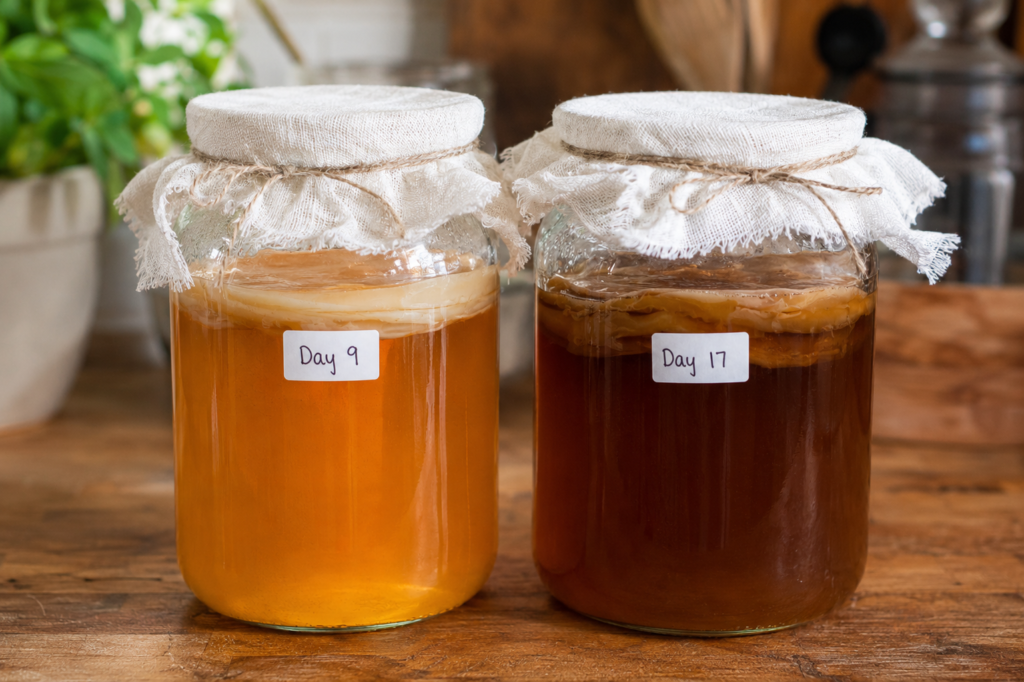
During normal fermentation in my standard brewing process, this happens gradually over 7–10 days at room temperature. The result is balanced: still slightly sweet, pleasantly tangy, with just enough acidity to give it character. But when fermentation continues past that sweet spot, the bacteria keep producing acetic acid. By day 14 or 15, you’re entering vinegar territory. By day 20, you’ve basically made kombucha vinegar.
According to peer-reviewed research on kombucha fermentation (NIH), the pH drops steadily as acetic acid accumulates, typically falling below 2.5 in over-fermented batches—that’s approaching the acidity of commercial vinegar.
The four main reasons your batch went too far
You left it fermenting too long
This is the number one culprit. Life gets busy. You forget to check your brew. I’ve done it more times than I care to admit—especially during summer when I had three batches going simultaneously and lost track of which jar started when. Every day beyond your target fermentation time increases acetic acid concentration. The bacteria don’t have an off switch.
Your kitchen is too warm
Temperature dramatically affects fermentation speed. At 75–78°F (24–26°C), a typical batch finishes in 7–10 days. But at 85°F (29°C)? You might hit peak flavor by day 5 and be in vinegar country by day 8. I learned this the hard way during a July heat wave when my apartment hit 82°F consistently. What normally took 9 days was finished in 6, and I wasn’t prepared.
You used too much starter liquid or a very mature SCOBY
A thick, well-established SCOBY contains massive bacterial populations. If you added a full 2 cups of strong starter tea plus a thick SCOBY to a 1-gallon batch, you front-loaded the fermentation with so much active culture that it accelerated everything. As Healthline’s guide to kombucha SCOBY explains, these cellulose mats house billions of microorganisms—more SCOBY means faster fermentation.
Your sugar ratio was off
If you used less sugar than recommended (some people try to make it “healthier” by cutting sugar), the yeast runs out of food faster. The bacteria then dominate the fermentation earlier, producing acetic acid without the balancing sweetness. I tested this once intentionally, using only ½ cup sugar instead of 1 cup for a gallon batch. It tasted like vinegar by day 8.
Is vinegary kombucha safe to drink?
Absolutely. In fact, it’s completely safe—just unpleasantly acidic. The high acidity (low pH) is precisely what protects kombucha from harmful bacteria. Pathogens can’t survive in such an acidic environment, which is why even over-fermented kombucha remains food-safe. I’ve accidentally let batches go three weeks, and while they tasted terrible, they never made me sick.
That said, the extreme acidity can be harsh on tooth enamel and might upset sensitive stomachs. Some people actually dilute vinegary kombucha with water and drink it as a digestive tonic, similar to apple cider vinegar. I’m not personally a fan of drinking it straight, but it’s a valid option if you don’t want to waste the batch.
What to do with over-fermented kombucha
Don’t pour it down the drain—vinegary kombucha has plenty of uses beyond drinking.
Use it as starter tea for your next batch. This is actually ideal. Strong, acidic kombucha makes excellent starter liquid because it quickly lowers the pH of fresh sweet tea, protecting the new batch from contamination. I always reserve 2 cups of my most vinegary brew for starting the next gallon. Works perfectly.
Make a second fermentation drink. Add it to a flavored second fermentation with fruit juice, fresh berries, or ginger. The added sugars from fruit will balance some of that acidity, and carbonation develops beautifully. I once rescued a completely vinegary batch by bottling it with strawberries and a teaspoon of honey per bottle—after three days of second fermentation, it was actually delicious.
Use it as cooking vinegar. Seriously. Kombucha vinegar works wonderfully in salad dressings, marinades, and anywhere you’d use apple cider vinegar. I made a fantastic vinaigrette last month with over-fermented ginger kombucha, olive oil, Dijon mustard, and honey. My dinner guests had no idea it came from a forgotten fermentation jar.
Try it as a household cleaner. The acetic acid has natural antibacterial properties. Dilute it 1:1 with water and use it to clean countertops, cutting boards, or glass. The smell dissipates as it dries, and it works surprisingly well.
How to prevent the vinegar taste next time
Preventing over-fermentation comes down to three things: timing, temperature control, and regular tasting.
Taste daily after day 5. This is non-negotiable. Starting on day 5 of primary fermentation, I taste my kombucha every single day. I keep a dedicated spoon near my brewing station. Insert the spoon below the SCOBY, pull out a small sample, taste it. When it hits that perfect balance of sweet-tart with just a hint of effervescence, it’s done. For me, that’s usually day 8 or 9, but it varies with temperature and SCOBY strength.
Monitor your fermentation temperature. Invest in a simple stick-on thermometer strip for your brewing vessel, or keep a room thermometer nearby. Ideal range is 68–78°F (20–26°C). Above 80°F (27°C), fermentation accelerates dramatically. Below 68°F (20°C), it slows down but doesn’t stop. I move my jars to cooler spots during summer heat waves and slightly warmer areas during winter.
Adjust fermentation time based on conditions. Hot kitchen in July? Check your brew at day 5. Cool apartment in January? You might need 12–14 days. There’s no universal timeline. Research published in a scientific review of kombucha’s active compounds (PubMed) confirms that temperature variations can alter fermentation duration by 40% or more.
Use consistent ratios. For a 1-gallon batch, I use exactly 1 cup of sugar, 8 black tea bags (or equivalent loose leaf), and 1½–2 cups of starter liquid. This ratio produces predictable results. When I deviate—more SCOBY, less sugar, different tea—the timing changes, and I need to watch more carefully.
Set phone reminders. I’m serious about this. When I start a new batch, I immediately set a reminder for day 5: “Taste kombucha.” Then another for day 7, and day 9. These simple alerts have saved multiple batches from the vinegar fate.
Can you fix kombucha that already tastes like vinegar?
You can’t reverse the acetic acid production—chemistry doesn’t work backwards. But you can dilute and blend it into something more palatable. Here’s what I’ve successfully done:
Mix it 50/50 with fresh sweet tea (cooled to room temperature). This immediately cuts the acidity in half. You’re essentially creating a new batch with a very strong starter. Let this mixed batch ferment for just 2–3 days, tasting frequently. The yeast will consume the added sugar, producing new flavors without overwhelming acetic acid.
Blend it with fruit juice at serving time. Pour equal parts vinegary kombucha and cold-pressed apple juice, or mix it with grape juice. The fruit sweetness masks much of the sharpness. Add ice, and you’ve got a drinkable beverage rather than a waste product.
Create a shrub-style drink. Add fresh herbs (mint, basil), a bit of honey, and sparkling water. Essentially you’re making a kombucha-based cocktail mocktail. I’ve done this with over-fermented hibiscus kombucha, fresh lime, and soda water—tasted like a sophisticated adult beverage.
Understanding the fermentation timeline
Here’s what typically happens in my gallon jars at 72–75°F room temperature:
Days 1–3: Not much visible activity. The SCOBY is settling in, yeast is beginning to consume sugar. Taste is still very sweet, with strong tea flavor.
Days 4–6: Sweetness starts dropping noticeably. You’ll detect the first hints of tanginess. A baby SCOBY layer begins forming on the surface. Small bubbles might appear at the edges.
Days 7–10: The sweet spot for most of my batches. Flavor becomes balanced: still slightly sweet but with pronounced tanginess, pleasant acidity, and subtle effervescence. This is when I bottle.
Days 11–14: Sweetness disappears almost entirely. Acidity dominates. Still drinkable if you like very tart kombucha, but approaching vinegar territory.
Days 15+: Full vinegar mode. Sharp, harsh acidity. Unpleasant to drink straight. Better reserved for cooking or as super-strong starter liquid.
Your timeline will vary, but this framework helps you know what to expect when tasting daily.
The bottom line on vinegary kombucha
Your vinegar-tasting kombucha isn’t a failure—it’s just over-fermented. It happens to every home brewer eventually. The key is catching it earlier next time through consistent tasting, temperature awareness, and careful timing. And even when you do let a batch go too far, you’ve got options: use it as starter, cook with it, flavor it heavily in second fermentation, or dilute it into something drinkable.
My current batch is on day 7, and I just tasted it an hour ago. Still a touch too sweet for my preference, so it’ll go another day. Tomorrow I’ll check again. That’s the rhythm of kombucha brewing—constant small adjustments based on direct sensory feedback. Once you dial in your specific conditions, you’ll rarely end up with vinegar again.
Frequently Asked Questions
How long does it take for kombucha to taste like vinegar?
14–21 days at normal room temperature (68–78°F). In warmer kitchens (85°F+), it can happen by day 8–9.
The exact timing depends on your kitchen temperature, SCOBY strength, and how much starter liquid you used. I’ve had batches taste vinegary as early as day 10 during summer, and others remain balanced until day 12 in cooler months.
Can I drink kombucha that tastes like vinegar?
Yes, it’s completely safe to drink. The high acidity (pH below 2.5) makes it food-safe—harmful bacteria cannot survive in that acidic environment.
However, the extreme tartness can be harsh on tooth enamel and may cause digestive discomfort in sensitive people. Many brewers dilute over-fermented kombucha with water or juice, or use it as a cooking vinegar instead of drinking it straight. That’s often the best option.
Does vinegary kombucha still have probiotics?
Absolutely. Over-fermented kombucha often contains higher probiotic concentrations than properly fermented batches.
The acetic acid bacteria, Lactobacillus species, and other probiotics remain alive and active. The strong acidity itself is evidence of thriving bacterial activity—those microbes are what produced all that acetic acid in the first place. You actually got more fermentation, not less.
How do I know when my kombucha is done fermenting?
Taste it daily starting around day 5. You’re looking for balance between sweetness and tartness—hint of sweetness but pronounced tanginess.
Use a clean spoon to extract a small sample from below the SCOBY each day. When it tastes right to you, immediately move to bottling or refrigeration to stop fermentation. There’s no universal day count because temperature, SCOBY strength, and other variables affect timing significantly. This is why daily tasting is the only reliable method.
Can I add sugar to vinegary kombucha to fix it?
No. Adding sugar won’t reverse the acetic acid already formed, but you can dilute it with fruit juice or fresh sweet tea instead.
Mixing vinegary kombucha 50/50 with fresh sweet tea or blending it with fruit juice will dilute the acidity and add balancing sweetness. However, if you add sugar and ferment it longer, you’ll just produce more acetic acid—making the vinegar taste even stronger. Better to dilute it at serving time or use it as cooking vinegar.
Home kombucha brewer based in Tel Aviv with 6+ years of experience and 500+ batches brewed. I started Kommbucha.com because the information online was scattered or just plain wrong — I wanted advice from someone who actually brews. My kombucha is sold at local Tel Aviv coffee shops and been gifted many times in Detroit, Michigan .