
✍️ Written & Updated by Ofir The Fermenter · 📅 July 22, 2026
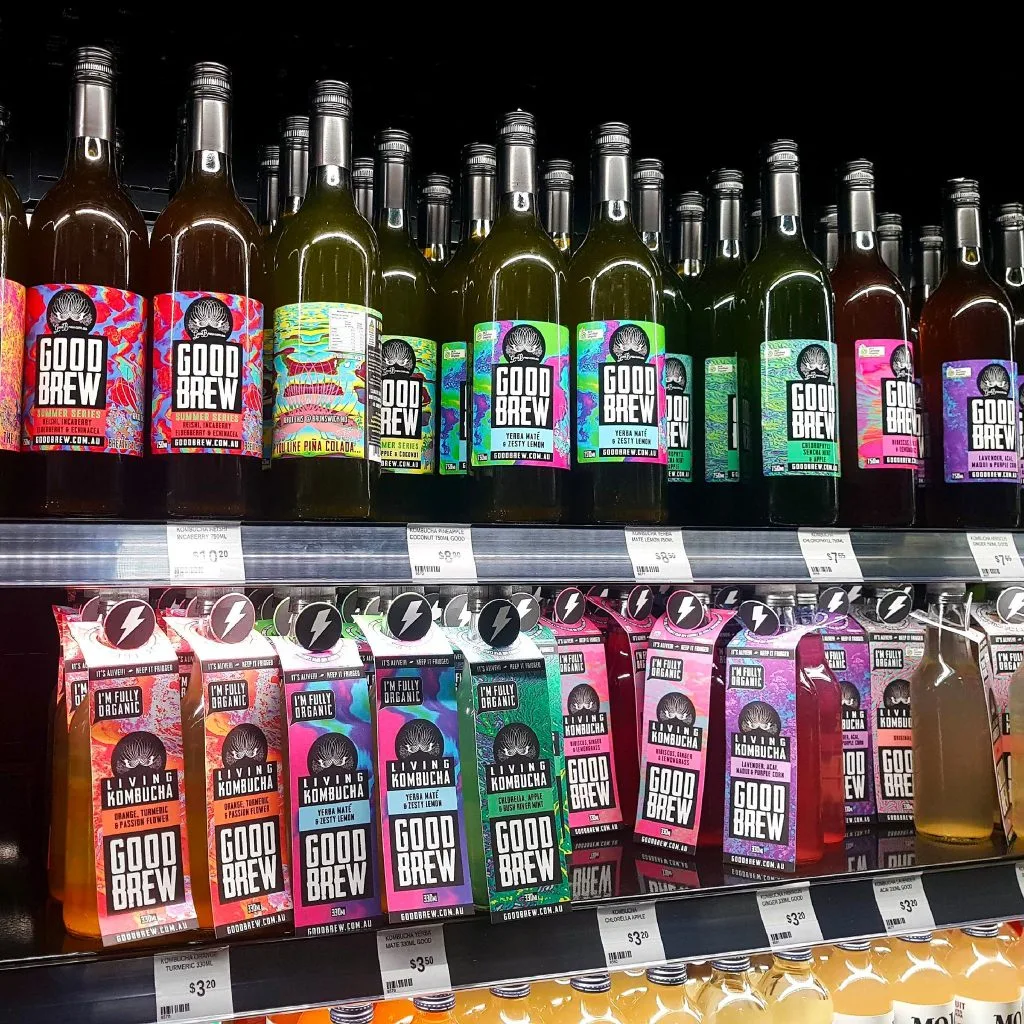
When I first connected with Deano, the owner and the brain of Good Brew via WhatsApp, I wasn’t expecting to be impressed. But within a few messages, I realized I was talking to someone genuinely different.
Deano’s story doesn’t begin with kombucha. It begins with solar panels, reusable cups, and a simple question: how do you throw a party without destroying the planet?
What unfolded from there is a story about integrity, corporate compromise, and why one founder decided to prove his product through science when major brands abandoned him. It’s a story about what happens when you refuse to cut corners, even when cutting corners is exactly what the industry expects.
The Beginning: Bikes, Music, and a Better Way
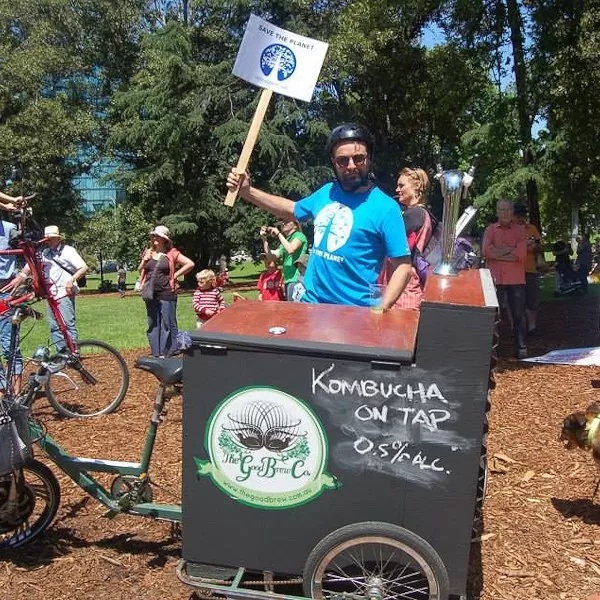
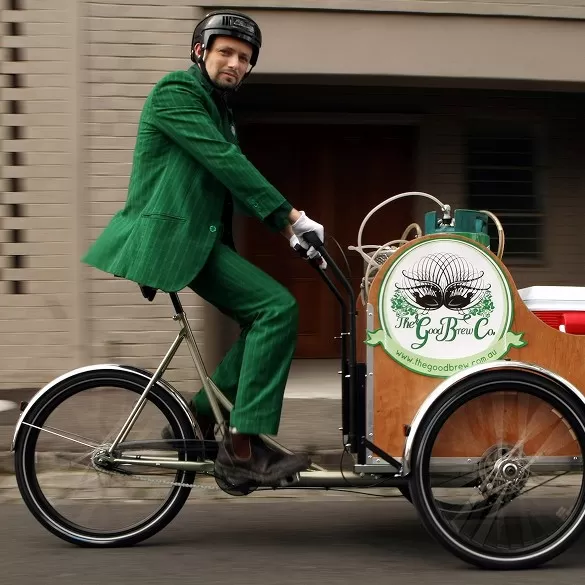
Good Brew started as an environmental experiment. Deano began with a single Christiania bicycle carrying 2x50L kegs and a tap system, designed to deliver beverages in reusable cups and eliminate single-use plastics from the party scene. It was a simple concept: mobile bars powered by human effort, not engines.
What started as one bike grew into a fleet. Deano designed custom bicycles outfitted with 3D-printed bar tops that glowed and pulsated in sync with music at festival stages. These weren’t ordinary bikes. They were delivery systems built on the principle of reducing waste. He built several of these quad bikes, each a mobile bar, each a small act of rebellion against wasteful convention. But the innovation didn’t stop there. Deano added GPS tracking to the bikes, allowing him to map distribution in real time and reach customers directly. When COVID hit and indoor hospitality collapsed, those GPS-enabled systems became something more valuable: a way to refill bottles in people’s homes when supply chains were broken and bars were closed.
The bikes were working. The concept was sound. But Deano was about to discover something that would change the direction of his entire business.
The Pivot: A Market Opportunity and a Realization
During the COVID period, Deano began producing kombucha vinegar at scale. Hundreds of thousands of liters of it. The product he was making was potent, complex, and full of gluconic acid. This wasn’t just a byproduct. This was a valuable ingredient for major kombucha brands looking to source raw materials.
The bigger brands came knocking. They wanted his vinegar. They wanted his expertise. They assured him that the final product would remain unpasteurized, that they understood the value of live fermentation. They gave him commitments. What they didn’t give him was honesty.
Deano began noticing something troubling. The brands he was supplying were pasteurizing his vinegar despite their promises. They were using heat to kill off the very complexity he’d worked to develop. For a fermented food entrepreneur, this felt like a betrayal. More than that, it was a lie.
At the same time, Deano was connecting with doctors and researchers in Melbourne who were genuinely interested in fermented foods. They tasted his kombucha. They were struck by something: Good Brew’s kombucha appeared to be the only truly live product still available in Victoria. Everyone else had either gone out of business or been absorbed into the kind of operations that prioritized shelf stability over fermentation integrity.
The Proof: Turning Frustration into Science
The conversation with researchers sparked an idea. If live kombucha truly was different from pasteurized versions, why not prove it? Not through marketing claims or testimonials, but through rigorous clinical research. This was risky. Expensive. Time-consuming. But it was also an opportunity to show, definitively, why his commitment to unpasteurized fermentation mattered.
Deano decided to fund the research himself.
Study 1: Mapping the Microbial Universe (2021)
The first study was published in Nutrients, conducted in partnership with RMIT University’s Pangenomics Group. Researchers used metagenomics amplicon sequencing to analyze the microbial composition of Good Brew’s kombucha. The results were striking: 34 genera and 200 distinct microbial species.
To understand what this means, consider this: a single glass of Good Brew kombucha contains hundreds of billions of microorganisms, each one a living cell that has survived the fermentation process. This is not a pasteurized drink. This is not a standardized product. This is living complexity.
The importance of this finding cannot be overstated. When you pasteurize kombucha, you kill this microbial ecosystem. You destroy the very thing that makes fermented foods potentially valuable. You turn living food into a dead beverage with fermented flavor.
Learn more about microbial profiling and fermentation science here.
Study 2: Proof of Metabolic Effect (2023)
The second study, published in Frontiers in Nutrition in 2023, tested something more direct: what does unpasteurized Good Brew kombucha actually do in the human body?
Using a randomized, single-blind, placebo-controlled crossover design, researchers had 11 healthy adults consume a high-glycemic rice meal under three conditions: with soda water, with diet lemonade, or with Good Brew kombucha. They measured blood glucose and insulin responses after each meal.
The finding: consuming Good Brew kombucha was associated with lower post-meal glucose and insulin responses compared to soda water. The effect was measured, specific, and reproducible under controlled conditions.
This wasn’t a miracle cure. It wasn’t a cure for diabetes. It was evidence that an unpasteurized fermented beverage had a measurable metabolic effect that a pasteurized alternative would not have. It was proof, in other words, that Deano’s commitment to live fermentation actually mattered.
The Breaking Point: When Research Becomes a Threat
The research was the straw that broke the camel’s back in Deano’s relationships with the major brands he was supplying. When they saw that he had proof of a genuine metabolic difference between unpasteurized and pasteurized kombucha, when they realized he could market himself as scientifically backed while they could not, the arrangement fell apart.
They ditched him. They found new suppliers. They sourced their vinegar from wine vinegar manufacturers instead. The message was clear: they didn’t want a supplier who was building a competitive advantage through integrity. They wanted a supplier who would be a commodity.
For Deano, this was actually a clarifying moment. His research had proven something important: his product genuinely was different. It worked differently. It mattered differently. Instead of fighting to maintain supply relationships with brands that didn’t value what he was doing, he could build a brand of his own around that difference.
Why This Matters in a Market Full of Lies
The kombucha market is built on promises. Brands promise gut health improvements, immunity support, and natural detoxification. They splash these claims across packaging and websites. Most of these promises are not backed by evidence. Many of them are made by brands that pasteurize their products, eliminating the very microorganisms that might theoretically support those claims.
Deano’s experience with major brands reveals an uncomfortable truth: the industry doesn’t always reward honesty. It doesn’t always reward the commitment to live fermentation. Sometimes it actively punishes it. The brands that make the biggest health claims are often the ones making compromises on product quality.
Good Brew took a different path. Deano funded research. He proved his claims. He didn’t just assert that his kombucha was better. He showed you, through peer-reviewed science, exactly why it was different. And he was transparent about the limitations of that research, about what it could prove and what it couldn’t.
In an industry full of marketing lies, this approach is revolutionary not because it’s perfect, but because it’s honest.
The Larger Lesson: Fermentation as an Integrity Test
Deano’s story offers a lesson that extends beyond kombucha. When a brand chooses to skip pasteurization, they’re making a commitment to complexity and variability. They’re saying that shelf stability matters less than fermentation integrity. They’re making a choice that costs more, takes more time, and generates more risk.
When a brand funds research on their own product, they’re placing a bet. The research might not show what they hope. The results might be modest or qualified. But they’re willing to take that risk because they believe in what they’re making.
These choices separate genuine fermented food brands from brands using fermentation as a marketing strategy. It’s the difference between a product and a label. Between integrity and convenience.
What the Research Actually Shows
Deano’s research is detailed and transparent. If you want to understand what the studies actually tested, what they found, and what they don’t prove, Good Brew has published everything:
Research page: https://goodbrew.com.au/about/research/
The microbial analysis identified 200 species. The glucose trial involved 11 people. The effect was specific to unpasteurized kombucha under specific conditions. Good Brew doesn’t hide these limitations. They explain them. They invite scrutiny.
This approach builds credibility because it doesn’t claim more than it can prove.
Where This Leads
Deano’s journey from environmental activist with solar bikes to kombucha producer to researcher represents something important. It shows what happens when you refuse to compromise on product integrity, even when compromise is the profitable choice. Even when major brands are offering supply relationships if you’ll only cut a few corners.
Good Brew competes in a market where most brands are competing on hype. They’re competing on evidence. They’re competing on transparency. They’re competing on the choice to stay unpasteurized and let science prove why that matters.
That’s not a business model that works for everyone. But it works for anyone who believes that what goes in your body should be backed by integrity as well as claims.
Learn More About Good Brew
If you want to understand Good Brew beyond the story, the research is where to start. Deano has published comprehensive details about both studies, methodology, results, and limitations.
Explore their full product range: https://goodbrew.com.au
Good Brew operates from Brunswick, Victoria, and ships across Australia. If you’re looking for kombucha that’s backed by research, transparency, and genuine commitment to unpasteurized fermentation, this is where that story begins.
Good Brew operates from Brunswick, Victoria, and ships across Australia. The microbial analysis was published in Nutrients (2021) with RMIT University affiliation. The glucose response trial was published in Frontiers in Nutrition (2023).

Home kombucha brewer based in Tel Aviv with 6+ years of experience and 500+ batches brewed. I started Kommbucha.com because the information online was scattered or just plain wrong — I wanted advice from someone who actually brews. My kombucha is sold at local Tel Aviv coffee shops and been gifted many times in Detroit, Michigan .