
✍️ Written & Updated by Ofir The Fermenter · 📅 June 30, 2026
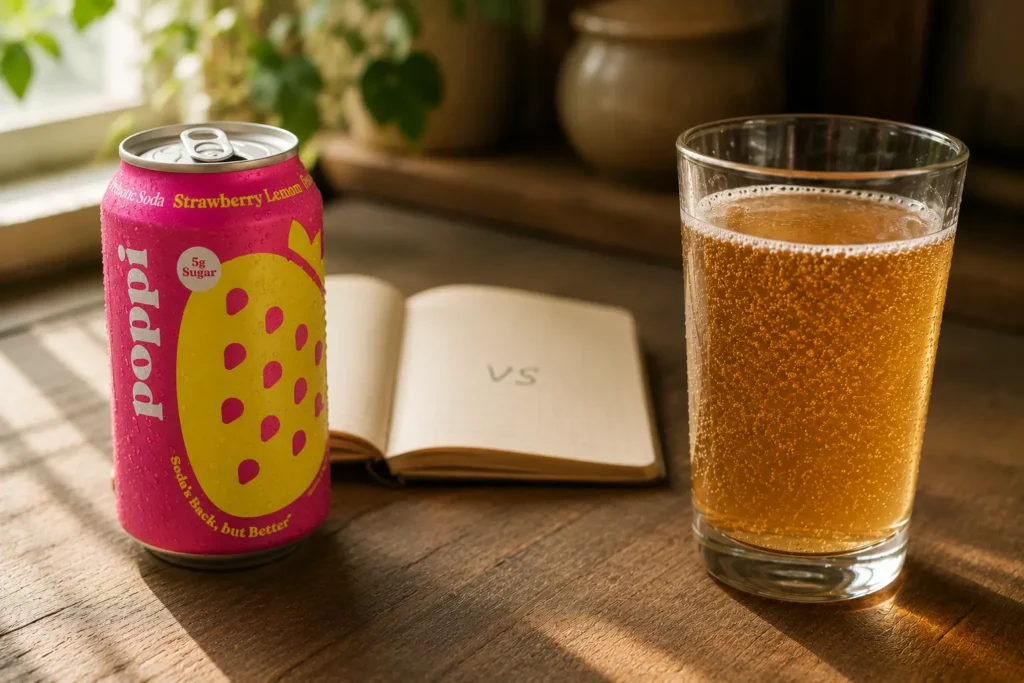
Kombucha vs Poppi is one of those comparisons that keeps coming up, and I get it. Both are fizzy, both lean into the “gut health” angle, and both look great on a grocery shelf. But they’re actually pretty different drinks doing pretty different things inside your body. Let me break it down honestly.
What Are These Two Drinks, Really?
Kombucha is a sweetened tea fermented by a symbiotic culture of bacteria and yeast, known as a SCOBY. That fermentation isn’t cosmetic: it’s a living process that changes the drink’s chemistry from start to finish.
The fermented tea contains vitamins, trace minerals, and antioxidants, compounds that can protect your cells from damage.
Poppi is made with prebiotic fiber from agave inulin and apple cider vinegar, and sweetened with cane sugar and stevia. It’s an American brand of prebiotic soda built around a “gut healthy” approach to the carbonated-beverage market, with each flavor coming in at 35 calories or less.
Think of it as soda that’s trying to do something good for you, which is a fair goal, just not the same thing as fermented tea.
How Kombucha Gets Its Gut Benefits (The Science Part)
Here’s the simple version of what’s happening in your brewing vessel. The SCOBY bacteria (primarily Acetobacter and Komagataeibacter species) convert the ethanol produced by yeast into acetic acid. That acetic acid, alongside lactic acid from lactic acid bacteria, is what gives kombucha its tart flavor and its antimicrobial properties.
You’re essentially drinking a controlled, living acid environment that also carries live microorganisms along for the ride.
Kombucha contains probiotic microbes purported to confer health benefits, including lowering blood pressure, protection against metabolic disease, and improved hepatoprotective activity. These include members of the Acetobacter, Lactobacillus, and Komagataeibacter genera.
Poppi doesn’t ferment anything. Inulin, the main prebiotic fiber used in these sodas, is isolated from plants such as agave or chicory root. It’s added in, not grown in.
That’s a meaningful difference if you care about how the ingredient was created.
Nutrition at a Glance

The Poppi Lawsuit: What Actually Happened
This is worth knowing if you’ve been buying Poppi for gut health reasons. A class action lawsuit filed in June 2024 alleged that Poppi’s prebiotic sodas were falsely advertised, given that they contained only two grams of prebiotic fiber, an amount too low to confer any meaningful gut health benefits.
The suit claimed that a consumer would need to drink more than four cans of Poppi in a day to realize any gut health benefits from the prebiotic fiber. As part of the settlement, Poppi agreed to pay a total of $8.9 million into a settlement fund.
The company did not admit wrongdoing, but the case puts the “gut healthy” label in a much more skeptical light.
To be fair to Poppi, Poppi and other prebiotic soda brands are better for you than regular soda, according to Caitlin Dow, a senior nutrition scientist at the Center for Science in the Public Interest. “Better than regular soda” and “meaningfully gut healthy” just aren’t the same claim.
What the Research Actually Says About Kombucha
Kombucha’s evidence base is growing, but it’s important to stay honest about where it stands. A small amount of research suggests that kombucha tea may give benefits similar to probiotic supplements, with some research suggesting it may support a healthy immune system and prevent constipation.
That said, there are few valid medical studies of kombucha tea’s role in human health.
Since kombucha is made from either black or green tea, you get the benefit of tea’s natural antioxidant properties. Antioxidants help protect cells against damage, and the process of fermenting the tea may increase these immune boosters.
The variability question is real too. Kombuchas not only vary from one producer to another but also from different batches of the same producer, making assumptions of quality and properties questionable. That’s especially true for home brewing, where fermentation time, temperature, and SCOBY health all affect the final product.
I’ve seen this firsthand: a small US coffee shop I advised had a house kombucha that kept coming out too sour until we pulled the first ferment a couple of days shorter, which totally changed the acid balance and the live culture count in the bottle.
Is Poppi’s Apple Cider Vinegar Actually Doing Anything?
Poppi soda also contains apple cider vinegar, which some small studies suggest can help lower blood sugars when consumed before a meal. But whether there is enough vinegar in a can of Poppi to have that effect isn’t clear, according to Carol Johnston, a professor of nutrition at Arizona State University.
This is a recurring theme with Poppi: the ingredients are real, the benefits are plausible, but the doses in a single can are likely too small to move the needle in a meaningful way. Kombucha, by contrast, produces its organic acids during fermentation rather than adding a small splash of vinegar at the end.
Sugar: A Closer Look at Both
Neither drink is loaded with sugar, and both beat a standard soda by a wide margin. Kombucha contains 2 to 10 grams of sugar per 8 oz (240 ml), mainly from residual sugar after fermentation.
The range is wide because fermentation time matters: a longer first ferment eats more sugar. At 4 grams of sugar per 12 fluid oz (355 ml) can, Poppi is significantly lower in sugar than most sodas.
The nuance here is that Poppi’s sugar is added cane sugar, not a fermentation byproduct. A nutritionist noted it would be better to get prebiotic fiber from other food sources that do not have added sugars, since excess sugar can harm gut bacteria, disrupting their delicate balance.
For home brewers, you can also push kombucha’s sugar lower by extending fermentation, something you simply can’t do with a canned soda.
Who Should Drink Which?
Both have a place. If you’re trying to ditch regular soda and want something that feels like soda, Poppi does that job well. It tastes familiar, it’s widely available, and it’s genuinely lower in sugar than a Coke or Pepsi.
You can explore more on how kombucha stacks up in the broader fermented-drink landscape on our kombucha vs other probiotics guide.
If your goal is actually supporting gut microbiome diversity, kombucha has a stronger biological argument. More research is still needed on kombucha probiotics to fully understand how kombucha manifests its potential gut health benefits. However, the combination of live microorganisms, organic acids, and antioxidants makes it a promising option for improving gut health.
Want a deeper dive into the evidence? Our full breakdown of whether kombucha is healthy runs through the research strain by strain. And if you’re thinking about brewing your own, the home brewing guides at Kommbucha are a solid place to start.
The Honest Bottom Line
Kombucha wins on biological complexity. It delivers live cultures, organic acids, antioxidants, and B vitamins, all produced naturally through fermentation. The science still has gaps, but the mechanism is real and the ingredient list is short.
Poppi wins on accessibility and taste for people who wouldn’t touch kombucha’s tang. It’s a genuinely better soda, just not the gut health powerhouse its old marketing suggested. Since the settlement, Poppi has dialed back the boldest claims, which is honestly more honest.
Pick kombucha for functional gut support. Pick Poppi as a soda upgrade. Don’t expect either to fix a poor diet on its own.
Frequently Asked Questions
Q: Does Poppi actually have probiotics?
A: No. Poppi contains prebiotic fiber (agave inulin) and apple cider vinegar, but it does not contain live probiotic cultures. Probiotics are living microorganisms; prebiotics are the fiber that feeds them. These are different things, and Poppi only provides the latter, in a relatively small dose.
Q: Is kombucha better for your gut than Poppi?
A: Based on what’s in each drink, yes. Kombucha delivers live bacteria and yeast, organic acids produced through fermentation, and polyphenols from tea. Poppi provides a small amount of prebiotic fiber that a class-action lawsuit argued was insufficient for meaningful gut benefits on its own. That said, kombucha’s evidence base in human clinical trials is still limited, so neither drink should be treated as a medical treatment.
Q: How much sugar is in kombucha vs Poppi?
A: They’re in a similar range. A plain 8 oz (240 ml) kombucha typically has 2 to 10 grams of sugar depending on fermentation length, while a 12 oz (355 ml) can of Poppi has about 4 to 5 grams of added cane sugar. Home-brewed kombucha fermented longer can come in at the lower end of that range, giving you more control over sugar content than you’d get from a canned product.
Q: Can I drink Poppi every day?
A: There’s nothing harmful about it for most people. It’s low in sugar, low in calories, and a clear upgrade over regular soda. Just don’t rely on it as your primary source of gut health support. Whole food sources of prebiotic fiber, like onions, garlic, and oats, provide far more fiber per serving than a can of soda.
Q: Is home-brewed kombucha healthier than store-bought?
A: It can be, depending on how it’s made. Home-brewed and artisanal kombucha often contains more diverse probiotic strains than mass-produced versions, and you have full control over sugar and fermentation time. The trade-off is consistency: without careful sanitation and process control, quality can vary batch to batch. Start with good equipment, a healthy SCOBY, and clean technique, and home brew tends to beat the commercial shelf product.
Ofir is a brewer, not a doctor, so anyone with a medical concern should talk to a healthcare professional.

Home kombucha brewer based in Tel Aviv with 6+ years of experience and 500+ batches brewed. I started Kommbucha.com because the information online was scattered or just plain wrong — I wanted advice from someone who actually brews. My kombucha is sold at local Tel Aviv coffee shops and been gifted many times in Detroit, Michigan .