

✍️ Written & Updated by Ofir The Fermenter · 📅 September 8, 2026
The relationship between kombucha and cholesterol is one of the most searched health topics around this drink. Animal studies look promising. Human trials tell a more complicated story.
What the Animal Studies Actually Show
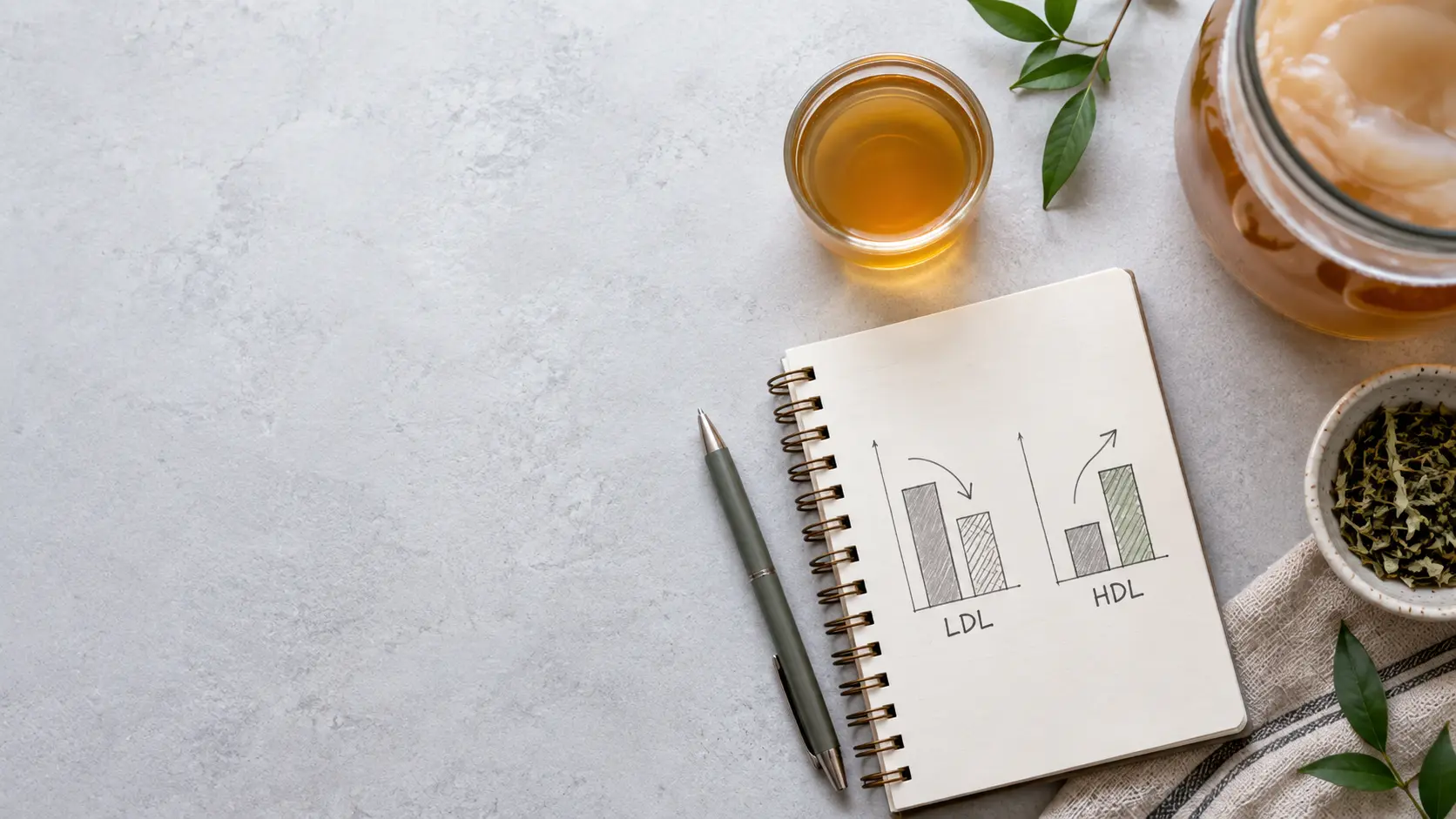
The animal data is genuinely striking. Kombucha induced lower serum cholesterol, triglycerides, VLDL-C, and LDL-C by 26%, 27%, 28%, and 36% respectively, while raising HDL in rats.
A rodent study found kombucha delayed LDL cholesterol and triglyceride absorption while increasing HDL. That’s a favorable shift on all key markers.
One rabbit study showed positive effects on hypercholesterolemia and arteriosclerosis. Results like these fueled popular health claims online.

The Proposed Mechanism: How It Might Work
Kombucha may decrease cholesterol by inhibiting HMG-CoA reductase, the enzyme controlling cholesterol production in the liver.
Think of HMG-CoA reductase as a factory assembly line for cholesterol. Slow the line, and output drops. Statin drugs target this same enzyme.
Kombucha’s polyphenols, especially catechins from tea, are suspected actors here. Secondary metabolites including acetic acid, gluconate, and D-saccharic acid also enhance cholesterol excretion via bile.
Soluble fiber inhibits cholesterol absorption and stimulates bile salt production. Niacin (vitamin B3) slows cholesterol production in the liver.
So Why Don’t Human Trials Show the Same Results?
This matters: a 2025 systematic review of eight human clinical trials concluded they “did not demonstrate significant improvements in lipid profiles.”
A four-week intervention study found no significant association between kombucha consumption and any lipid marker. An eight-week controlled study also found no significant changes.
An eight-week trial exploring kombucha supplementation in healthy individuals on a Western diet observed no significant changes in biochemical parameters.
The gap between animal and human results is common in nutrition science. Dosing, diet quality, gut microbiome differences, and short study durations complicate the picture. Only eight clinical trials have examined kombucha in humans, with sample sizes of 11 to 60 participants and durations of 10 days to 10 weeks. That is simply not enough data.
What Kombucha Does Contain That Matters
Kombucha is a package of active compounds, not one magic ingredient. Main metabolites include ethanol, gluconic acid, and acetic acid, plus polyphenols such as catechins, theaflavins, and flavonoids.
A 15-year observational study at the University of Latvia reported some antioxidant effects and blood cholesterol reduction. It is a data point without a control group.
For broader context, see benefits of kombucha, and for balanced risk information, check kombucha side effects, risks and safety.
Where This Fits in the Bigger Health Picture
Recent human trials consistently show gut microbiome improvement. Multiple trials show kombucha increases beneficial bacteria including Bifidobacterium, Akkermansia, and butyrate-producing Subdoligranulum.
Gut health and lipid metabolism are linked. Future research may find a connection between improved microbiome and cholesterol levels, but that is still a hypothesis.
For a full science breakdown, read about whether kombucha is actually healthy.
A Realistic Take From Someone Who Brews It
I dropped bottles at a neighborhood cafe and watched customers enjoy them. Nobody asked for a cholesterol panel.
Kombucha is a genuinely interesting fermented drink with real bioactive compounds. It is not a substitute for a statin or medical advice.
A peer-reviewed Foods journal review of kombucha production and microbiology offers thorough coverage of fermentation science and the current evidence.
How to Get the Most Out of Kombucha for Heart Health
- Choose low-sugar bottles. Look for under 6 grams per 8 ounces (240 mL) serving.
- Pair it with whole foods. Poor diet quality offsets any cardiovascular benefit kombucha might offer.
- Watch serving size. Most studies used roughly 8 to 12 ounces (240 to 360 mL) daily. More is not better.
- Use it as a soda replacement. Swapping sugary drinks for kombucha is a real dietary win.
The Bottom Line on Kombucha and Cholesterol
The mechanisms are plausible and animal results are encouraging. Human evidence simply does not back up a cholesterol-lowering claim. That gap deserves honesty.
Kombucha is worthwhile in a health-conscious diet. It is not a lipid-lowering drug. Treat it as a bonus, not a fix.
Q: Can kombucha lower my LDL cholesterol?
A: Not reliably based on current human evidence. Animal studies show 26 to 36% LDL reductions, but eight human clinical trials found no statistically significant changes in LDL, HDL, or total cholesterol. The mechanisms are plausible, but human data is too limited.
Q: How much kombucha would I need to drink to affect cholesterol?
A: No effective human dose has been established because no human trial confirmed a cholesterol effect. Animal studies used amounts scaled to body weight that would not directly translate to a daily serving. Until human dose-response trials exist, there is no evidence-based answer.
Q: Does kombucha raise HDL (good) cholesterol?
A: In rodent studies, yes. Kombucha consistently raised HDL while lowering LDL in high-cholesterol models. In human trials, one study found HDL dropped in the control group rather than rising in the kombucha group. Human evidence remains inconclusive.
Q: Why do animal studies and human studies disagree?
A: Human diets, gut microbiomes, and genetics are far more variable than lab animal conditions. Human trials have been short (under 10 weeks) and small (under 60 people). Compounds that work reliably in controlled rodent models often show weaker effects in diverse human populations.
Q: Is kombucha still worth drinking if I have high cholesterol?
A: Yes, as a dietary habit alongside your doctor’s guidance, not as a replacement. Kombucha may support gut health and provides antioxidants from tea. Choose low-sugar varieties, keep portions to about 8 ounces (240 mL) daily, and continue any prescribed treatment.
Ofir is a brewer, not a doctor, so anyone with a medical concern should talk to a healthcare professional.

Home kombucha brewer based in Tel Aviv with 6+ years of experience and 500+ batches brewed. I started Kommbucha.com because the information online was scattered or just plain wrong — I wanted advice from someone who actually brews. My kombucha is sold at local Tel Aviv coffee shops and been gifted many times in Detroit, Michigan .